
Which Cooling Solution Is Best for Industrial Electrical Enclosures?
Variable frequency drives, PLCs, power supplies, and other electrical components continuously generate heat inside industrial electrical enclosures. If that heat is not removed effectively, elevated temperatures can shorten component lifespan and affect overall system reliability.
When selecting an enclosure cooling solution, it is important to look beyond the rated cooling capacity. Ambient temperature, air quality, available space, and maintenance requirements can all have a significant impact on real-world performance.
Air-to-air heat exchangers and compressed air cabinet coolers are two common solutions for cooling sealed electrical enclosures. Both help protect sensitive electronics from external contaminants, but they operate in different ways.
How Air-to-Air Heat Exchangers Work
Air-to-air heat exchangers use the temperature difference between the inside of the enclosure and the surrounding air to remove heat. Many systems use heat pipes to improve heat transfer efficiency. Because the enclosure remains sealed, dust and moisture are kept out.
Limitations of Air-to-Air Heat Exchangers in High-Temperature Environments
The cooling performance of an air-to-air heat exchanger decreases as ambient temperatures rise. In hot production environments, the temperature difference may become too small to remove heat effectively.
Dust, oil mist, and other contaminants can also reduce performance. Build-up on heat-transfer surfaces and clogged filters lower efficiency and increase maintenance requirements.
Advantages of Compressed Air Cabinet Coolers
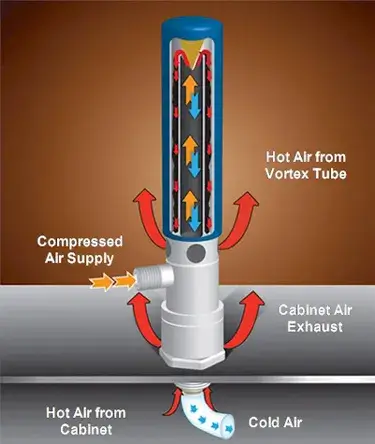
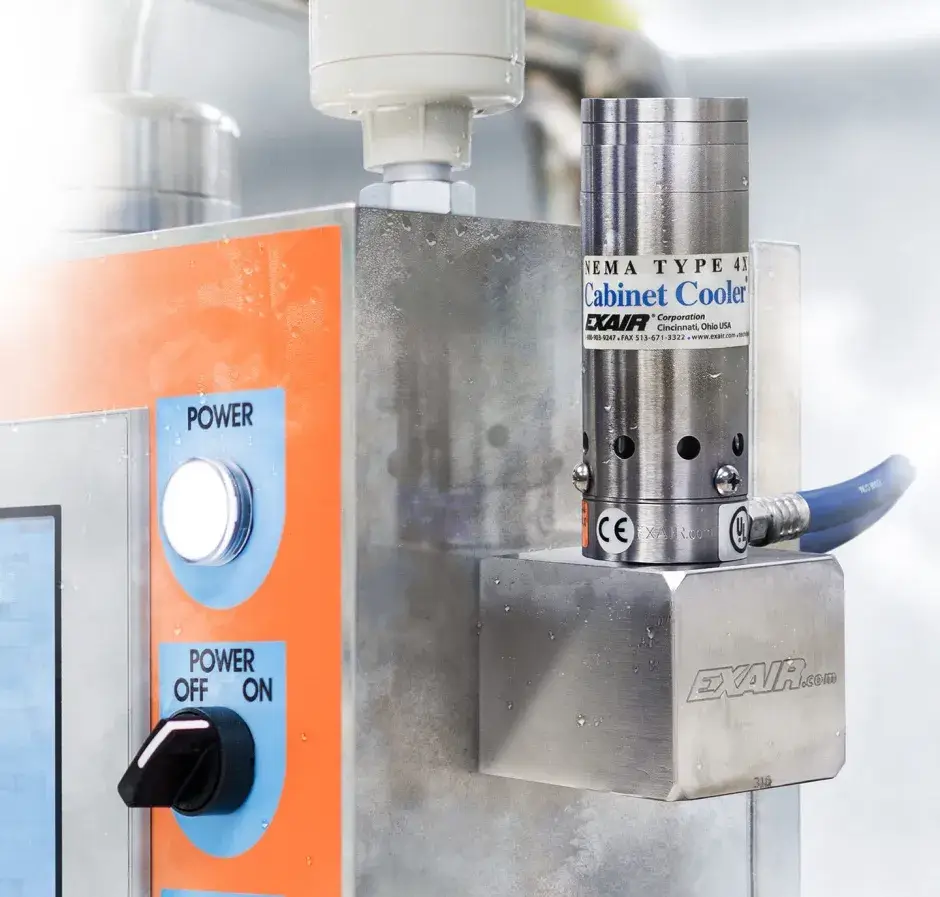
Compressed air cabinet coolers generate a stream of cold air directly inside the enclosure. Their performance does not depend on ambient temperature but on the availability of compressed air, making them particularly suitable for high-temperature or contaminated environments.
They also often require less installation space than comparable heat exchanger systems and operate without moving wear components, which can help reduce maintenance requirements.
Air-to-Air Heat Exchanger or Compressed Air Cabinet Cooler?
Air-to-air heat exchangers are a good choice when:
- ambient temperatures remain sufficiently below the target enclosure temperature,
- the surrounding air is relatively clean.
Compressed air cabinet coolers offer advantages when:
- ambient temperatures are high,
- dust, oil, or other contaminants are present,
- installation space is limited,
- a compressed air supply is already available.
Choosing the Right Cooling Solution
Both air-to-air heat exchangers and compressed air cabinet coolers can provide reliable enclosure cooling. The best choice depends on environmental conditions, heat load, and the resources available at your facility.
Not sure which cooling solution is right for your application? Contact us for expert advice. We’ll help you assess your operating conditions and identify the solution that best matches your cooling requirements, available space, and production environment.