
Buying a compressed air receiver can’t be that hard, can it?
For experienced users, that may well be true. Even so, many of our customers are glad to receive good advice when making their decision. Better safe than sorry. Not least because TÜV inspection also plays a role with compressed air receivers…
Your question was not answered in our FAQ? No problem, simply send us an email: info@eputec.de
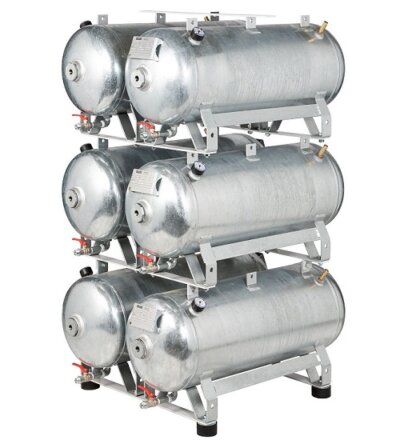
What are the advantages of compressed air receivers? Does it have anything to do with the type of compressor?
- Buffering compressed air: This is particularly useful with screw compressors, as they usually produce valuable compressed air continuously, even when air demand is low at the time. If a receiver is available, the surplus compressed air can be stored there. If the consumption later exceeds the compressor’s free air delivery, a buffer tank helps to bridge this phase. For the user, the compressed air reserve means more flexibility in sizing the compressor and in the number of consumers.
- Damping pulsations: Piston compressors generate pulsations that can disrupt the operation of sensitive equipment. A compressed air receiver installed between the compressor and the consumer smooths the flow so that volume fluctuations no longer occur.
- Minimising compressor cycles: By storing compressed air, compressors have to run fewer cycles, which puts less strain on the motor.
- Cooling and drying: If the air first passes through a receiver, it cools down there. Part of the moisture separates out as condensate, which relieves the load on the dryer. However, this sequence is not always suitable, especially as correct compressed air treatment is a complex subject. Please seek advice from a specialist company.
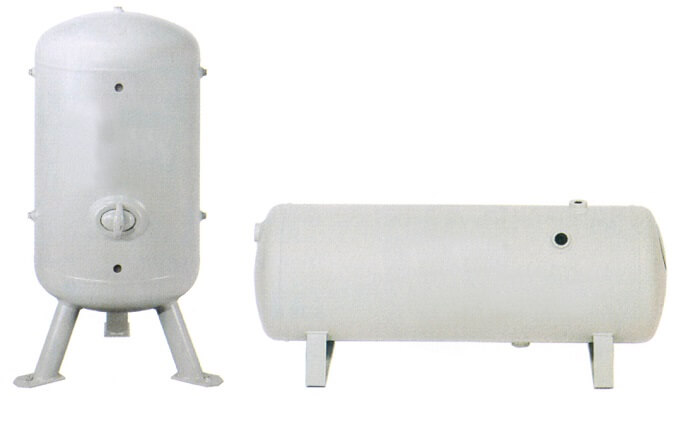
Vertical or horizontal receiver: which version is better?
Neither version is better, but there are differences in footprint. A vertical receiver is more compact in this respect, which is an advantage where space is tight.
At the same time, there are compressors that are mounted on a horizontal receiver. Taking into account the floor space saved for the compressor, this version also uses the available space very efficiently.
Do I need a compressed air receiver at all?
Compressed air receivers are essential components of industrial compressed air systems and should definitely be taken into account at the planning stage. Although the reasons vary, a storage unit usually makes sense, regardless of the type of compressor. With piston compressors, the air receiver is always included, because the motor receives the signal to start from the pressure drop in the receiver.
What is an AD2000 receiver?
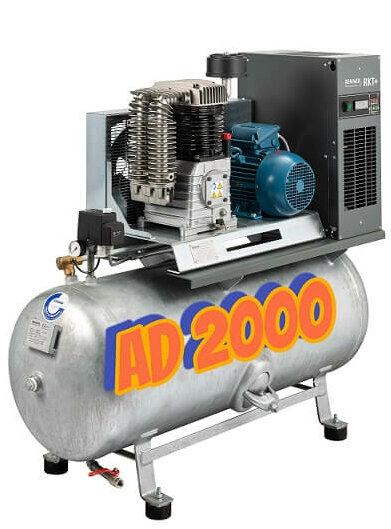
An AD 2000 receiver is not a specific type of receiver, but a pressure vessel manufactured in accordance with the AD 2000 code. This code summarises and specifies the testing requirements of the European Pressure Equipment Directive. It is written by the Arbeitsgemeinschaft Druckbehälter (AD, Pressure Vessel Working Group) in cooperation with the DGUV, the VDMA and other stakeholder groups. The publisher is the TÜV-Verband e.V.
The authors’ aim was to formulate the safety requirements in a practical and understandable way. However, the AD 2000 code is not a standard in the strict sense, but a conformity assessment for pressure equipment in the EU. In Germany, the AD 2000 data sheets are often regarded as a national code and effectively fulfil the function of a standard. Thanks to its clear structure and generous inspection intervals, AD 2000 is very popular with both manufacturers and operators of pressure vessels.
What is the difference between galvanised and powder-coated air receivers?
As is so often the case, it depends on the intended use and the environment of the pressure vessel. Personal preferences regarding the appearance of the receiver can also influence the decision. Ultimately, both coating options have their advantages and disadvantages:
- Galvanised air receivers are made of sheet steel coated with a layer of zinc on both sides. The zinc layer protects the material from corrosive substances and makes it durable. Metallic galvanising is a popular choice for industrial products and outdoor equipment exposed to the elements. However, it is not as visually appealing as other coating options and tends to rust over time, as the layer can wear away.
- Powder-coated receivers are covered with a layer of plastic powder that is applied to the receiver and then heated to melt and cure. This surface coating also provides excellent corrosion protection and is more wear-resistant than galvanising. Besides its good durability, powder coating is also popular for visual reasons, as it can be customised in different colours. However, powder-coated receivers are generally more expensive.
What volume should the air receiver have? What size suits my compressor?
The optimum size of the compressed air receiver depends on various factors. These include the compressor’s output, the expected consumption and the type of application. There are rules of thumb based on the compressor’s free air delivery, but these do not take customer-specific factors into account. We therefore recommend seeking advice directly from a specialist dealer to ensure an adequate compressed air supply and to relieve other equipment in the compressed air system as much as possible.
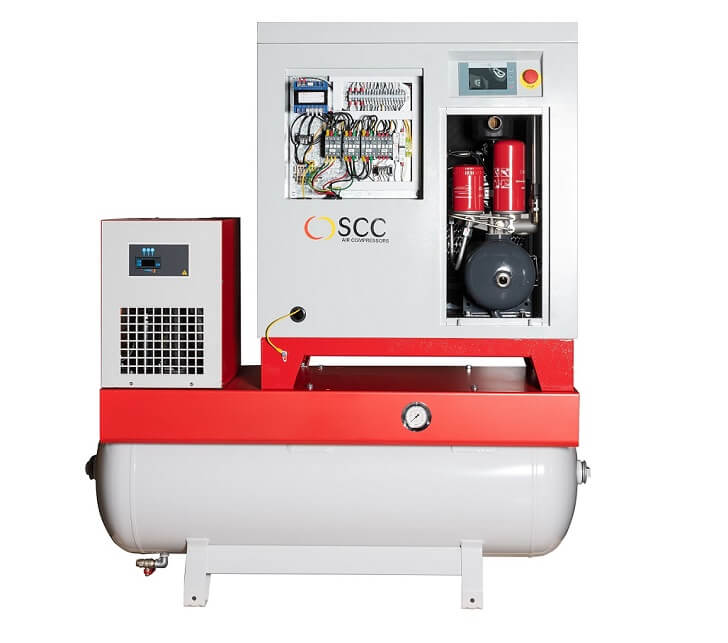
Why does TÜV inspect my compressor?
- Pressure vessels above a certain size or capacity must be inspected by an approved inspection body (ZÜS) before they are first put into service. A qualified expert examines the installation and checks whether the technical documentation complies with the regulations. The receiver and the fittings (safety valve, pressure gauge, …) are also visually inspected.
- In addition, German regulations require pressure vessels to be re-examined after a certain period and after any modifications subject to inspection. The ZÜS is also responsible for this. For smaller receivers, the periodic inspection can be carried out by a “competent person” (bP). These are technical specialists with the appropriate qualifications.
- In Germany, the inspection of pressure vessels is governed by the Ordinance on Industrial Safety and Health (BetrSichV, Annex 2, Section 4). Here the operator of the pressure system can look up when which inspections (internal, external, pressure test) are due and in which cases a bP is authorised to carry them out.
Where can I find information on the Pressure Vessel Ordinance (DruckbehV)?
Even though regulations from the DruckbehV are still frequently found online or in older manuals, it has been obsolete for many years. As early as 2015, the Pressure Vessel Ordinance (DruckbehV) was replaced by the Ordinance on Industrial Safety and Health (BetrSichV). In Annex 2 (Section 4: Pressure systems) you will find all the important regulations for the safe operation of compressed air receivers.
My screw compressor runs reliably around the clock. Should I still have an air receiver?
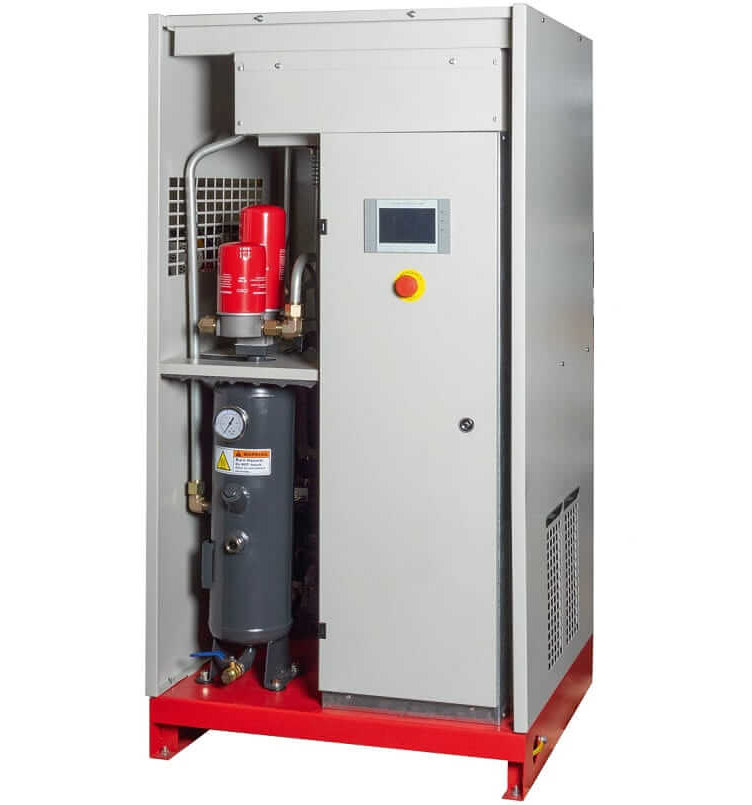
Although requirements and conditions differ in every company, we would answer this question with YES. For process reliability, it is usually essential to store a compressed air reserve so that it can be used when needed. For example, when several consumers are switched on at the same time and their combined compressed air demand exceeds the compressor’s free air delivery. In addition, the required amount of compressed air is available more quickly if the compressor has been switched off. Even if the operating principle of a screw compressor (unlike a piston compressor) does not require compressed air storage, it improves the overall efficiency and functionality of the compressed air system.
Air compressors and high-quality accessories from the specialist
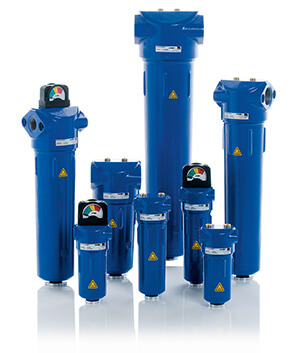
Energy-efficient production and lasting cost savings: anyone who regularly uses large quantities of compressed air may already be planning to modernise their system. This includes smart solutions for compressed air optimisation as well as high-quality filtration technology with the lowest possible pressure drop.
Are you looking for technical advice or a customised solution?
We are here for you: by phone, by email and on site!


Daniel Amacher (Switzerland)
Tel. +41 52 53 / 37 964
Mobile +41 76 231 06 73
daniel.amacher@eputec.de
We are happy to support you with:
– Planning, project design & installation of compressed air systems
– Loan units for testing
– Custom builds for your specific requirements
– Technical safety advice & requirements analysis