
How can large weld seams be cooled so that the next layer can be welded sooner? And could waiting times be cut so much that productivity rises and the welders also get noticeable relief?
A machine builder from the Black Forest asked itself exactly these questions. We were able to support the company in its search for a new cooling solution and were surprised ourselves by the result of the optimisation.

Welded structures for demanding applications
Our customer is a leading manufacturer of plant for the process industry and is known for the durability of its steel structures. Their joints are so strong that they withstand even heavy mechanical loads. To achieve this quality, our customer relies on multi-layer welding, which produces high-strength weld seams.
The interest in weld seam cooling arose from the long waiting times between applying the individual layers. Unproductive phases like these are not only uneconomical but also tiring and exhausting for the welders.
On top of this, the parts made here often have very wide and deep weld seams. That in turn means applying a particularly large number of individual layers, and therefore even more breaks.
Cooling weld seams: how can it be done better?
Attempts had already been made to cool with compressed air, but without real success. So the company decided to consult the experts at EPUTEC Drucklufttechnik GmbH. During an on-site visit, our account manager quickly had an idea of what more effective weld seam cooling could look like.
To speed up the process, he recommended installing EXAIR cold air guns, specifically the Spot Cooler and Cold Gun series.
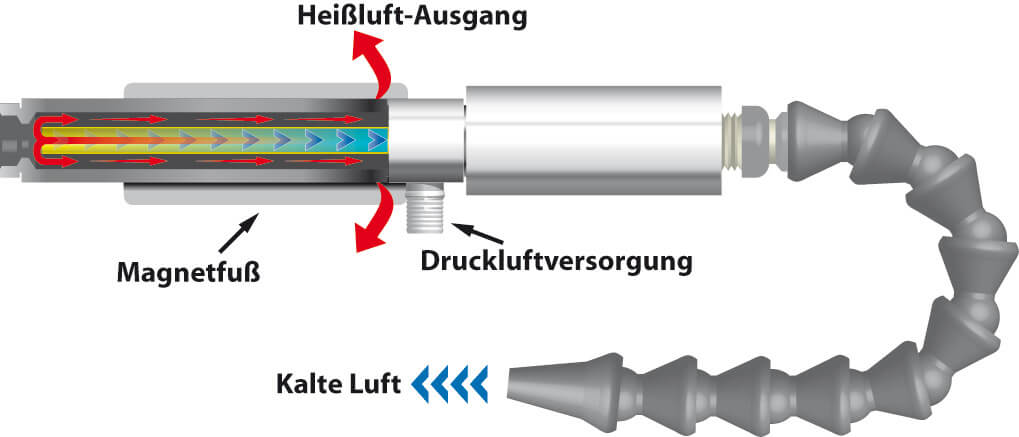
The vortex tube technology they contain works without moving parts and needs no electricity, making it a reliable and cost-effective solution for industrial cooling problems.
Loan units in a field test: what do the cold air guns deliver?
But who likes to buy a pig in a poke? Fortunately, with EPUTEC there is no risk involved:
Thanks to our no-obligation loan unit service, the welding shop was able to test the two cold air guns (each with a dual air outlet) for a month under real conditions.
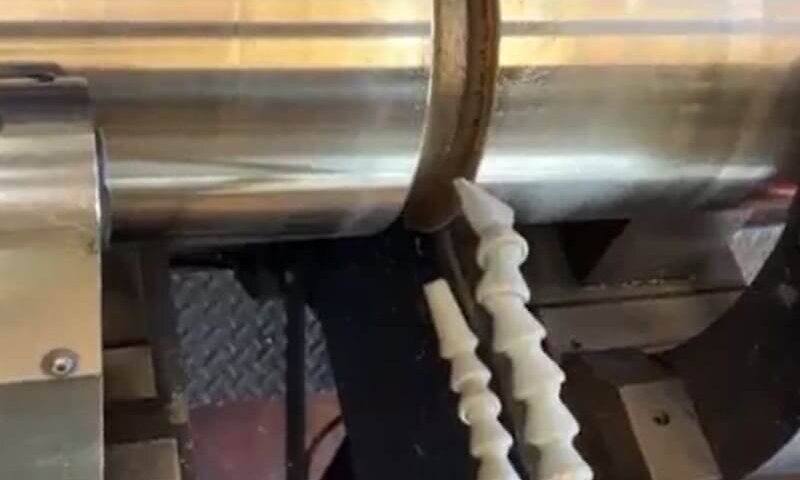


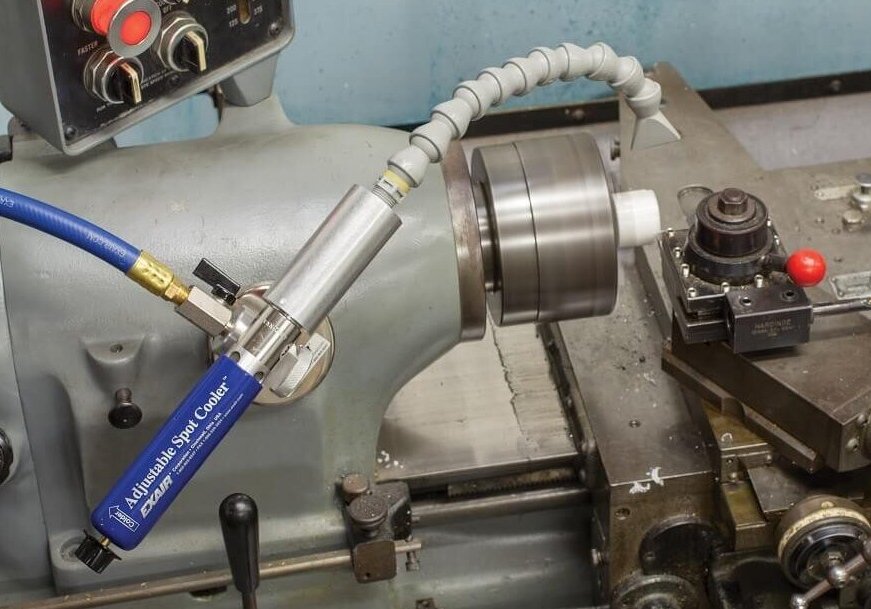
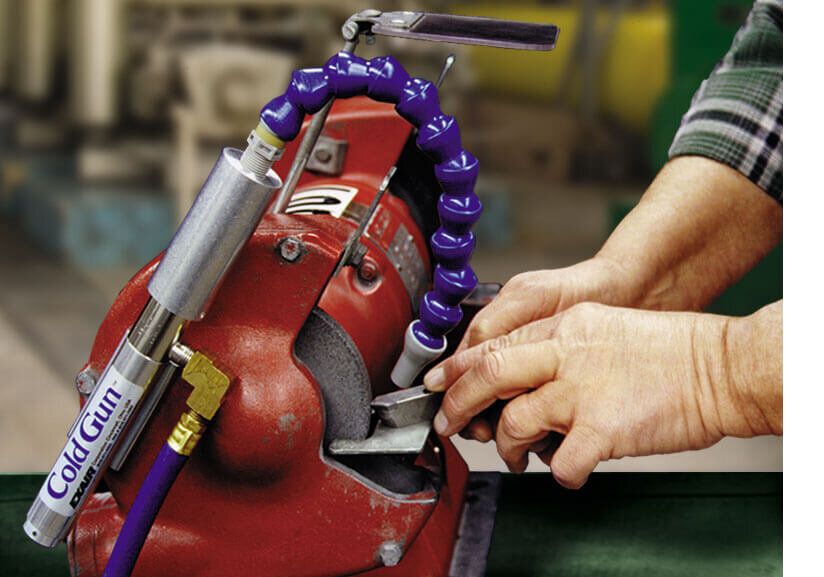
First, the Adjustable Spot Cooler (model BP3925J) and the High Power Cold Gun (model BP5330J) were used in the production of smaller components. Both vortex tubes use compressed air as their energy source and, unlike maintenance-intensive wet systems, cool without any liquid at all.
At the customer’s request, the test phase was then extended by several months so that valuable experience could also be gained when welding more massive components.
This trial showed it too: it works, and how!
With the EPUTEC loan units, the processing time for all components fell significantly. In one application around 50 min of waiting time was saved, and elsewhere it was even more than 60 min. Specifically, the cooling phase was cut from 76 to 10 min here, just 13 % of the original duration!
Switching to our compressed air-powered EXAIR cold air guns can therefore be expected to bring a significant cost reduction. At the same time, valuable capacity is freed up because skilled workers are no longer tied up on a project for so long.
Last but not least, employees were more satisfied during the test phase, as they could work through with fewer interruptions and had to put on and take off their protective clothing less often.
The encouraging results of the trial phase are now being put into everyday practice. As a first step, several workstations are being equipped with the high-performance Cold Gun BP5330J system.
And while this is already expected to deliver a noticeable increase in production, further plans are on the table. We are looking forward to seeing which project comes our way next.
Spot Cooler and Cold Gun: what is the difference?
We offer a range of cooling solutions for optimising industrial applications. Two popular products are the Adjustable Spot Cooler and the EXAIR Cold Gun.
Despite their similarities, we recommend the two series for different applications. While the Spot Cooler offers better adjustability, the Cold Gun scores under constant conditions. The choice between these two devices ultimately depends on the specific requirements of the process and on whether operators should be able to make further adjustments.
| Similarities | Differences |
|---|---|
|
|
Good to know: both devices run on compressed air and are based on the vortex tube principle. We would be happy to explain exactly what this means and how process-reliable cold air is produced in no time from hot compressor air. You will find the contact details below.
We have also described the key facts about this ingenious invention here:
Vortex tube products – cooling with compressed air