
The chip vacuum from EXAIR is a great product, if you know what it can be used for. And what matters during installation…
Unfortunately, in today’s example two basic mistakes were made, which meant the “Chip Vac” chip vacuum could not function.
A case for EPUTEC customer service!
First things first: this air operated vacuum was not supplied to the end customer by us but reached the user via a third party (a machine builder). As a result, we were unable to give important installation advice or a general extraction recommendation beforehand.

Something’s not right here! Contacting EPUTEC customer advice
Fortunately, the production staff eventually noticed that the normally powerful industrial vacuum was nowhere near delivering the required performance. We received a description of the problem by email: the collection bag stayed empty while the work area remained dirty. Our customer advisers found this odd, as these air operated vacuums normally work perfectly. Because of the unusual symptoms, our sales engineer decided to see for himself and promptly drove to the plant (the first photo shows the situation on arrival).
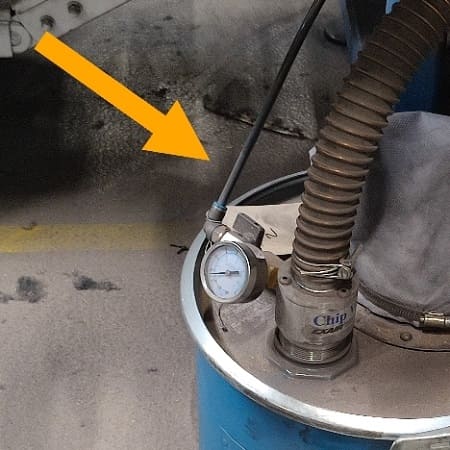
Where’s the air? The chip vacuum runs out of puff
On arrival in the production hall, the compressed air line to which the chip vacuum was connected immediately stood out. The flexible hose (see arrow) had a diameter of no more than 6 to 8 mm, making it too small for the intended application.
By way of explanation: in compressed air applications, as well as the operating pressure of the compressor, the volume of air delivered per unit of time (standard cubic metres per hour) is essential for process reliability. The same applies to the air volume actually reaching the end consumers such as air nozzles, safety air guns, etc. (standard litres per minute).
For our Chip Vac, this means the compressed air hose must have an inside diameter of 3/8 inch (approx. 9.5 mm) to prevent a drop in performance pressure.
Where are the chips? A chip vacuum with nothing to do
Once the compressed air supply had been sorted out, there was a second surprise when our specialist asked about the chips that a Chip Vac is normally used to extract. There were no chips anywhere to be seen.
Instead, this machine was producing only hazardous metal dust that was so fine it could easily pass through the Chip Vac’s filter bag. We had not expected that. A chip vacuum was therefore completely out of place here and definitely not what we would have offered for this application.
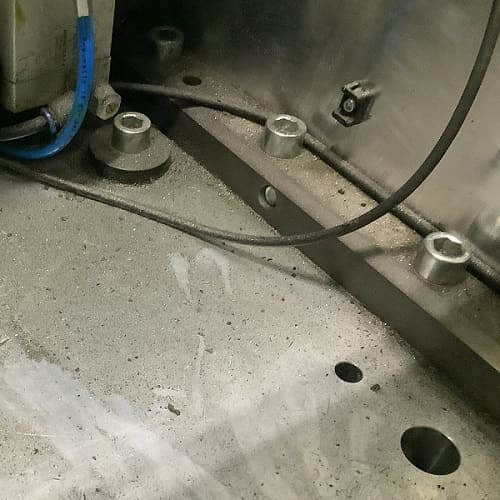
We always find a solution! And sometimes even two
We were at least able to offer the operations manager two straightforward solutions. After a brief check of the local conditions, we recommended either retrofitting an Exair air amplifier to convey the dust to the central extraction system, or alternatively an air operated industrial vacuum with HEPA filter to protect the machine operators’ airways effectively. And the unemployed Chip Vac is sure to find another place soon where it can finally show what it is capable of.