
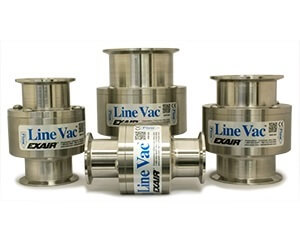
The Sanitary Flange Line Vac is the ideal solution for customers who want to convey bulk materials in food and pharmaceutical applications, among others. The Sanitary Flange Line Vac works in the same way as Line Vac air operated conveyors with smooth hose ends or NPT male thread Line Vacs. It is available in the following flange sizes: 1-1/2″ (19 mm), 2″ (25 mm), 2-1/2″ (32 mm) and 3″ (38 mm). All Sanitary Flange Line Vacs are made from type 316 stainless steel and are therefore particularly corrosion-resistant.
Hygienically clean: ideal for the food and pharmaceutical sectors
There are various types of flange in industry. The Sanitary Flange Line Vac conforms to the ISO 2852 flange standard. The standard specifies the dimensions, tolerances, surface roughness, materials, assembly and hygiene requirements for the flange. These flanges are intended for use with stainless steel pipes as specified in ISO 2037. ISO 2852 is the international standard that defines the connections for non-permanent food-grade piping systems. These are typically used in the pharmaceutical, food processing, dairy and agricultural industries.
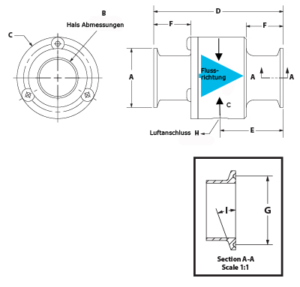
In these industries, components must be thoroughly cleaned and disinfected. With this type of connection, the components within the piping system can easily be removed, disinfected and then reassembled.
A gasket is then placed between the individual pipe sections. A raised groove at each end allows it to sit on the corresponding end of each flange. A clamp is then fitted on the outside, pressing the sections together and compressing the gasket. This creates an airtight seal.
Applications for the Sanitary Flange Line Vac in various industries
The Sanitary Flange Line Vac can be used in a wide range of industries. Here are three application examples:
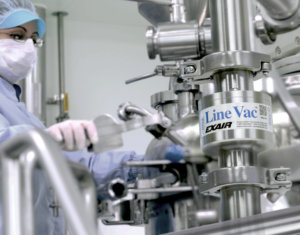
- A pharmaceutical manufacturer used a maintenance-intensive blower conveyor belt for transporting capsules. When it installed a stainless steel piping system fitted with sanitary flanges and a Sanitary Flange Line Vac (model 161150-316 1-1/2″) instead, the time-consuming maintenance was eliminated entirely.
- Another plant uses the same model to convey caps. This allows our customer to avoid contamination by aluminium particles, which had been a problem with other conveyor systems.
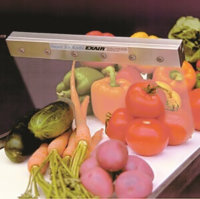
3. A machine builder specialising in food processing uses the model 161300-316 3″ Sanitary Flange Line Vac. It uses it to remove the casings from pepperoni sticks before they are sliced and then packaged. The casing remnants are conveyed into a waste container. The customer also uses the model 110006SS 6″ stainless steel Super Air Knife. This blows the cut casings into the intakes of the Line Vacs.
Adapting the Sanitary Flange Line Vac to cleanliness requirements
The sanitary flanges are compatible with stainless steel clamp pipe couplings and meet the strict cleanliness requirements of the food and pharmaceutical industries. Many people also know them as Tri-Clamp, Tri-Clover or aseptic flanges.
Our products are easy to fit and remove for regular maintenance. The sanitary flange is specially designed to limit the areas where bacteria can settle (e.g. along the flanks of NPT threads). This makes complete and thorough decontamination easier.
These and other features have also proved beneficial for other users of these Line Vacs:
A chemical plant needed to convey long strands of cotton horizontally over a distance of 18.3 m to a waste container. The company opted for a system with sanitary pipes, as these have a smooth inner surface. This means the fine cotton threads cannot catch on irregularities on the inner walls, as they would with other pipe types. The users installed a model 161150-316 1-1/2″ Sanitary Flange Line Vac, as it conveys the waste easily over the long distance.
This is just a small selection from a wide range of applications involving the conveying of bulk materials. Our Sanitary Flange Line Vac helps you handle them quickly, easily and cost-effectively. If your processes currently use piping with sanitary flanges, the Sanitary Flange Line Vac may be the ideal solution for you too, to transport bulk materials quickly, safely and efficiently from one point to another.