
The operating principle of a vortex tube is surprisingly different, and many manufacturing companies are not yet familiar with it. We, however, are convinced that this cost-effective and maintenance-free cooling solution will prove itself in many applications because it offers enormous benefits for industry. But read on and see for yourself:

Vortex tubes make use of a fascinating physical phenomenon and, using ordinary compressed air as the energy source, generate two air streams inside them. These two air streams, one hot and one cold, can be adjusted via an adjustable valve on the hot air side. The vortex tube was discovered by chance as early as 1928 by the French physics student George Ranque, who, however, failed to market it commercially. It was only the German physicist Rudolph Hilsch who brought renewed attention to the vortex tube with a scientific paper in 1945. This is why it is also known as the “Ranque-Hilsch vortex tube” or the “Hilsch vortex tube”.
How It Works
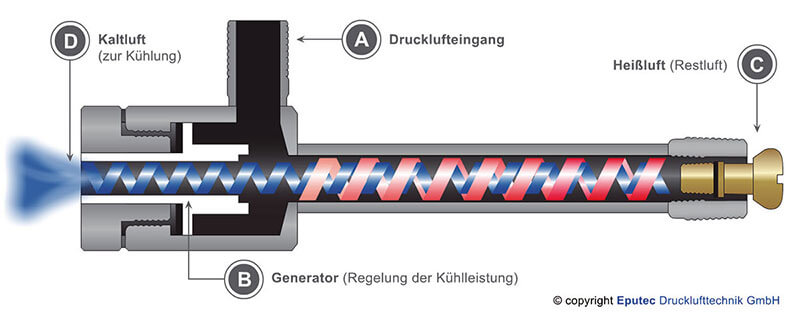
The areas of use for a vortex tube in industrial applications are very diverse, ranging from cooling during processing and cooling parts, chambers and laboratory samples to testing circuits. The exact way the vortex tube works is not fully understood, and there are various theories that attempt to explain the principle. In general, however, it is assumed that the compressed air stream, which is driven tangentially through a generator into the vortex chamber at 5.5 to 7 bar, behaves like a tornado in the tube. Rotating at up to 1 million revolutions per minute, this air stream spins towards the hot end, where some of it escapes through a control valve.
The remaining air, still spinning, is forced back through the centre of the outer vortex. The inner stream gives up its kinetic energy in the form of heat to the outer air stream and exits the vortex tube as cold air. The outer air stream, as shown in the illustration above, exits at the other end as hot air. The vortex tube is a simple, reliable and direct means of cooling. Nevertheless, its possible uses remain largely unknown in industrial practice. We offer a whole range of products that use vortex tubes.
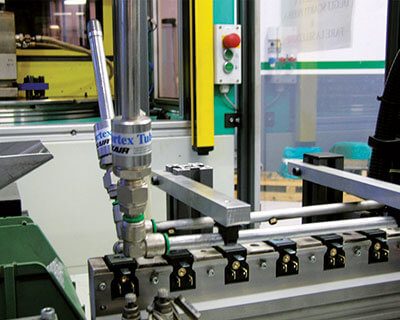
Two medium vortex tubes cool a solenoid coil after a welding process.
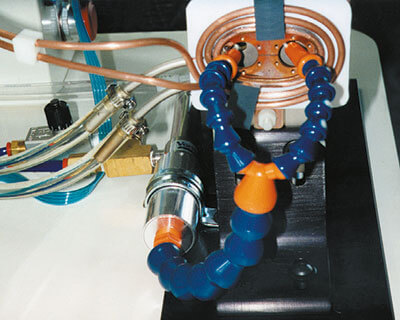
A vortex tube cools a moulding die used to make medical tubing.
Maximum cooling (80 % cold fraction) is achieved when the cold air temperature is 28 °C below the compressed air temperature. Opening the valve reduces the cold airflow and the temperature of the cold air. Accordingly, closing the valve increases the cold airflow and therefore the temperature of the cold air. “Setting up a vortex tube is child’s play with a thermometer,” says Managing Director Peter Endhart. Exair vortex tubes are made of stainless steel and are offered in three sizes. Each size can produce a specific airflow, which is determined by a small insert, the generator. The American manufacturer specifies a range of temperatures from -46 degrees Celsius to +127 degrees Celsius for its vortex tubes, flow rates from 28 to 4,248 l/min and a cooling capacity of up to 2,570 kcal/hr or 2,985 watts. The performance of a vortex tube is also determined by other factors, such as the back pressure at the cold air end. A back pressure of just 0.3 bar changes the achievable performance by 2.8 degrees C. The inlet compressed air temperature is another factor, because the temperature difference the vortex tube can produce depends on the temperature of the incoming compressed air. A change in inlet temperature will therefore produce a correspondingly different cold air temperature.
Practice shows that the vortex tube is extremely well suited to a large number of cooling problems in industry. The maintenance-free vortex tube also offers the option of increasing the flow rate by changing the generator inside the vortex tube. A particularly popular and practical variant of the vortex tube is the cabinet cooler.
