
A failed customer trial showed that aluminium, the popular all-round material, does not work here. For this application, a stainless steel air nozzle is clearly the better choice.
When pictures say more than any technical specification…
Our loan equipment service recently received a test unit back and was astonished when unpacking it: the once precise air nozzle was badly deformed and completely unusable.

So how could this happen?
Our EXAIR compressed air nozzles are certainly not cheap junk, but high-quality compressed air solutions made in the USA.
Our customer knows: you learn by trying!
A manufacturing company wanted to test the targeted use of air nozzles under real conditions. For this, we provided an EXAIR Super Air Nozzle 1100 including mount (12″ flexible hose, item 9212) as a loan unit. We cannot trace exactly what was tested on site, nor would we publish such details.
What is clear, however, is that considerable mechanical forces were at work and the nozzle material was clearly too weak for them. Which brings us to the important question:
Why are our air nozzles available in different materials at all?
You might think the material does not matter, since the air flows through the openings practically “without contact” and there is usually no contact with tools, machines or other media either.
But which material are we actually talking about?
The EXAIR Super Air Nozzle 1100 supplied to the customer is made from a zinc-aluminium alloy in its standard version. For many industrial uses, this material is a good compromise. The reasons are:
- an attractive balance of price and strength
- low weight
- robust enough for many standard applications
When the going gets tough, aluminium reaches its limits
But not every application is “standard”. The photos of the deformed nozzle clearly show that low-cost materials reach their limits in certain environments, and a compromise is then no longer enough.
This applies in particular to harsh production conditions with
- strong mechanical impact,
- high temperatures,
- aggressive chemicals,
- electromagnetic influences, and
- in foundries or heavy industry.

A versatile alternative: stainless steel air nozzles
For exactly these applications, EXAIR also offers the Super Air Nozzle in stainless steel versions (e.g. 303 or 316). These offer better temperature resistance, corrosion resistance, resistance to deformation and impact, and an overall longer service life even under extreme conditions.
Particularly in industries with high-temperature processes, in metalworking or in plants with heavy mechanical loads, stainless steel is often the more economical choice, even though the products cost more to buy.
As so often, the application decides.
The damaged return impressively shows that material specifications are not a minor detail. While aluminium-zinc is often perfectly adequate, there are still areas of use where we would recommend other materials such as stainless steel or even PEEK.
As a high-performance thermoplastic, PEEK is of interest whenever the requirements go beyond what conventional metals can withstand in the long term. If you are unsure which version suits your application, we will be happy to help you choose.

Super Air Nozzle in aluminium-zinc

Super Air Nozzle in 316 stainless steel

Super Air Nozzle in PEEK
Another real-world example: damaged aluminium Super Air Knife
It is not only our air nozzles that show how important the right choice of material is. A customer also returned a badly damaged aluminium Super Air Knife to us. As well as heavy contamination, the air knife showed significant material damage, including holes right through the aluminium.
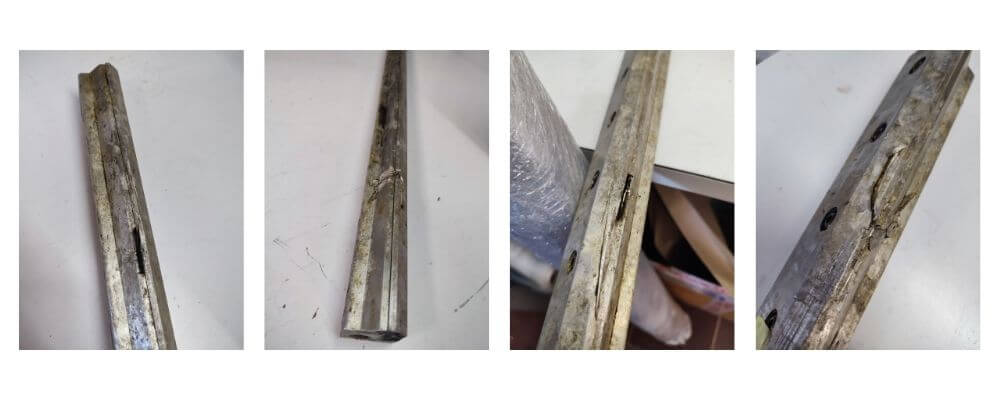
The damage suggests that mechanical impact may have played a role alongside the ambient conditions. Of course, we cannot determine the exact cause of such severe damage remotely.
For the replacement, we therefore recommended a stainless steel Super Air Knife (type 303 or 316) to our customer. In many applications, the higher purchase cost pays off through a much longer service life and greater resistance to demanding operating conditions.