

When a liquid is atomised, tiny particles are formed. The rule is: the smaller the particles, the larger the relative surface area. So-called two-fluid nozzles make use of this when they use compressed air to atomise a fluid particularly finely. Thanks to the better surface ratio, correspondingly less fluid is needed to cover the target area. And atomising nozzles offer further advantages, such as their versatility.
What many people do not realise is that the range of possible applications is by no means limited to traditional component suppliers or the metal industry.
From apples to gear wheels
Pharmaceutical companies, beverage manufacturers and food producers now also swear by these little helpers. Our spray nozzles are used, for example, to apply preservatives or disinfectant solutions to extend the shelf life of food and prevent the growth of germs.
In general, atomising nozzles are used whenever a liquid (or viscous) substance is needed in the form of very fine droplets. Depending on the type of operation, this may be oil, paint, lubricant or simply water applied as a spray mist. Spray angle, spray pattern, droplet size and spray volume vary according to the requirements and application. Even stubborn dust that disrupts process reliability in production plants can be bound in this way.
Two-fluid nozzles need compressed air
The image shows two connections for pressure lines. The liquid to be atomised flows through one of them. This liquid must be pressurised (except with our siphon nozzles). The other connection is reserved for the compressed air, which serves as the auxiliary medium. When the supplied compressed air meets the liquid at high velocity, the liquid is “atomised” and directed where it is needed.

Because two different media are involved in this process, this type of nozzle is also called a two-fluid nozzle.
With two-fluid nozzles, we distinguish between internal mix and external mix types.
This means that the media are either mixed together inside the nozzle or only meet after leaving it through separate orifices.
Internal mix spray nozzles prove themselves in standard applications
Internal mix atomising nozzles appeal to many customers because they produce a particularly fine mist and numerous spray patterns. Typical applications include dust control, minimum quantity lubrication and very thin coatings.
However, the liquids must not be too viscous: some models already reach their limit at 300 cP. When choosing an atomising nozzle, users should therefore always take the viscosity of the substances used into account.
The advantages of external mix atomising nozzles
External mix atomising nozzles are designed for media with high viscosities and do not clog as quickly as internal mix nozzles. High flow rates are also possible where required, which makes it easier to apply industrial paint, fire-protection coatings or a thick coating, for example.
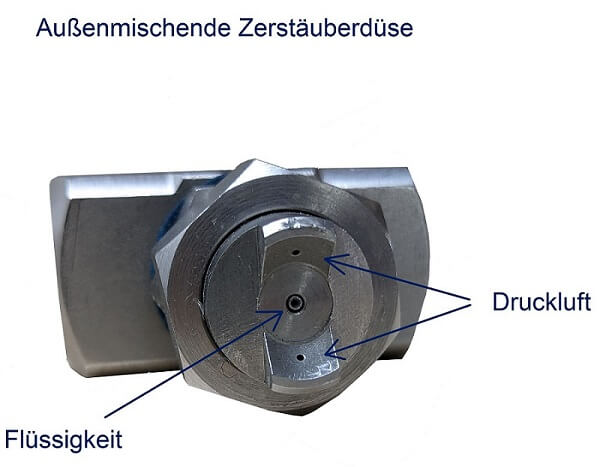
Precise control of the flow rate is another advantage. Because mixing takes place outside the nozzle, the ratio of liquid to compressed air is completely flexible.
In practical terms, this means you can throttle one line and increase the flow rate in the other. A powerful spray jet therefore does not necessarily have to contain a lot of liquid.
Why separate control of compressed air and liquid can be decisive is explained in this case study from the beverage industry: External mix atomising nozzles optimise bottle cleaning
Support from the compressed air experts
Interested in the products in this article?
Our catalogue lists nozzles with various connection sizes, flow rates and spray patterns.
Would you like to discuss a specific application? Our technical advisers will be happy to help.
Need help with installation?
Our experienced team can find a solution for that too.
Did you know? Many of our products are available as loan units, so you can see the results for yourself in a practical test.
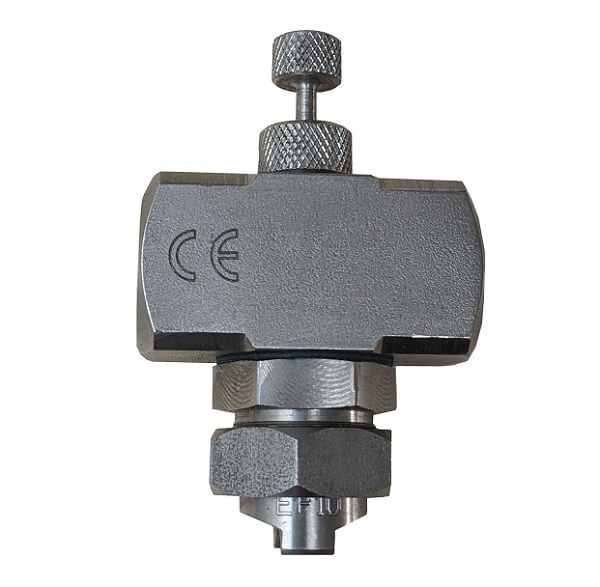
Stainless steel spray nozzle