
Blower or air knife: what is the difference?

Customers occasionally ask us about the difference between the high-pressure air knife “Super Air Knife” and visually similar blower-driven solutions. Although these are fundamentally different systems, a few key characteristics can be compared.
Precise blow-off
First things first: our compressed air operated air knives are unbeatable when it comes to targeted blow-off. Why? Because they are the most compact solution for large surfaces, and at the same time they generate the least noise. But let us take things one at a time: here are the most important advantages over a blower.
Space requirements and installation effort
- Powerful blower systems are complex to install and take up a lot of space. Integrating them requires qualified plant mechanics to lay electrical cables, controls and pipework. Holes have to be drilled in the floor to mount the blower, and a damping chamber may need to be built to reduce the blower’s high noise level. The system must then be validated by testing. This can take days.
- Installing the Super Air Knife takes hardly any time at all. All you need is a compressed air source* with a simple pipe or hose connection and a pressure regulator. When using the universal mounting kit, a 13 mm hole is enough for fixing. Even if you had to make a custom bracket instead, the material and labour hours are negligible.
[*Depending on the compressor and the humidity and contamination level of the ambient air, compressed air treatment is recommended to protect downstream equipment. In our experience, such equipment is often already in place. In that case, commissioning usually requires no additional effort beyond bolting on the air knife and connecting it to a compressed air line, because the existing compressed air system can be used.]
Do you want warm or cold air?
Blower-driven systems are not only very loud, they also get very hot as a result of the blower running. While this may be desirable in some applications, in others this effect would be a considerable disadvantage. Especially, of course, in cooling applications.
The air discharged by a blower is in the region of 82°C. If the target temperature for your material is significantly lower, this is understandably not a good option.

One advantage of the Super Air Knife is its amplification ratio. The total volume of air leaving the unit consists of 40 parts ambient air and 1 part compressed air. This means that the temperature of the outflowing air is almost the same as the ambient temperature.
So if the aim is to cool a hot material to a temperature slightly above ambient, the Super Air Knife is ideally suited to the task.
Maintenance and wear
With a blower system, regular maintenance is an important prerequisite for trouble-free operation. This includes changing the blower’s filters regularly and checking that the mechanical and electronic components are working properly, which takes time and increases operating costs. In addition, blower motors are heavily stressed devices. The bearings wear and the motor can fail. As soon as a mechanical defect occurs, production has to stop until the blower is repaired. In the worst case, more time passes before an important spare part arrives.
The Super Air Knife has the unbeatable advantage of working entirely without moving parts. So there are no components that could wear out. Nor is there any sensitive electronics. Failure of the air knife is therefore ruled out. The only requirement is proper use with dry, clean compressed air.
Difference in noise generation
- How pleasant is it when a pneumatic drill is at work 10 m away? That is roughly how loud an industrial blower is, generating a lot of noise from its motor and the turbulent airflow. On average this means a sound level of around 93 dBA, which would require personal protective equipment for anyone working nearby.
- By comparison, a Super Air Knife is significantly quieter. At a pressure of 7 bar, the sound level is only 72 dBA, which is roughly the background noise of an open-plan office.
Additional materials and space-saving design
By the way: if air knives made of aluminium, stainless steel or PVDF are unsuitable because of their material properties, we can switch to new materials for the Super Air Knife air knife, such as flexible, temperature-resistant PVC-C (chlorinated polyvinyl chloride) or glass-filled PEEK thermoplastic.
For applications with limited space, you can also request shorter or thinner profiles.
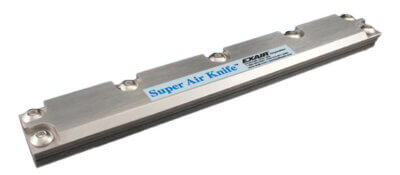
Extra-flat custom design for an electronics manufacturer.
Different design, different application
Can air knives and blowers really be compared in a meaningful way? And in which applications are air knives the better choice?
- A blower gives us a large volume of air that exits through a wide opening. This may be desirable, for example, for drying vehicles in a car wash.
- An air knife, on the other hand, has a much narrower slot through which less air can be directed at higher pressure. The result is a laminar and highly precise airflow that shows its strengths in industrial production systems, where it is used for cooling or blow-off.
We are here for you: by phone, by email and on site!
High-quality air knives are available in the EPUTEC online shop: Air Knife
If you would like to discuss an individual application, our >> technical advice team will be happy to help you personally.
We also offer loan units and support with installation. Because only when you are satisfied are we satisfied too.