
Because air compressors use a lot of electricity to generate compressed air, it is important to use it as efficiently as possible and save compressed air. We list seven simple steps and show you how to optimise your compressed air system. This allows you to lower your electricity costs, reduce your overheads and improve your bottom line.
In Part 1 of this blog series we explain basic measures and recommendations you can implement before replacing installations in your compressed air system or adding technical aids and accessories.
Step 1 – Measure Air Consumption
Measure air consumption to find sources that use a lot of compressed air. This information is important for diagnosing wasteful and problematic areas within your compressed air system. To measure air consumption, flow meters are used to determine the volume or mass of compressed air per unit of time. Flow rates are very useful data points for finding problems such as leaks, overconsumption in blow-off operations, waste calculations and comparative analyses.
There are many different types of flow meter. Find our digital flow meters here.
Step 2 – Find and Fix Leaks
One of the biggest problems in compressed air systems is leakage. That quiet hissing noise from the pipework costs your company a lot of money. A university carried out a study to determine the percentage of air leaks in a typical production plant. In a poorly maintained system, it was found that on average 30 % of compressor capacity is lost through air leaks. With a 100 hp compressor, you lose 30 hp to the surrounding air. This is an example of an inaudible leak in hundreds of metres of compressed air lines. Unlike a hydraulic system, compressed air is clean, so leaks will not be visible at the source. You have to locate them by other means.
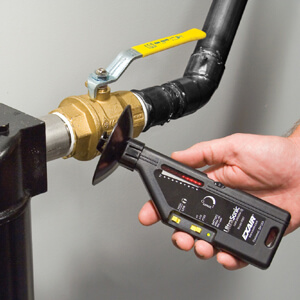
Most leaks occur where you have fittings, connections, hoses and pneumatic components such as valves, regulators and drains. The optimisation product line was developed to improve your compressed air system and help you save compressed air. The ultrasonic leak detectors can find the air leaks, and the digital flow meters can monitor your system for air leaks. By adding these two products to your leak prevention programme, you can run your compressed air system optimally and reduce the “hidden” costs of leakage.
Ultrasonic leak detector: https://www.eputec.de/prozessueberwachung/druckluftoptimierung/exair-optimierung-leckdetektor/
Step 3 – Use Efficient and Engineered Quiet Products
Compressed air is expensive, so using it efficiently is almost essential. A 1/4″ copper tube blow-off can consume up to 934 l/min when supplied with compressed air at 5.5 bar. This already produces a good, strong blow-off. You can crimp the end of the tube and reduce consumption to around 566 l/min. With a Super Air Nozzle Model 1100 with a compression fitting, however, you use only 396 l/min. If you track your compressed air consumption, you will see that replacing just one of these nozzles already saves around 77,500 standard cubic metres in a 5-day working week (8 hours per day). If you are in the room with the nozzle, you will also notice a dramatic improvement in noise. The sound level of the copper tube is probably above 100 dBA, while that of the Super Air Nozzle is just 74 dBA.
Drilled pipes are another common way of creating a blow-off. They are simple and cheap, but noisy and expensive to run. A pipe drilled with 1/8″ holes and supplied at 5.5 bar consumes 368 l/min per hole, and the holes are typically drilled at 1/2″ centres. An air knife of this model uses only 82 standard litres/min per inch of length (25 mm) and is also much quieter. Drilled pipes are essentially open-ended blow-offs, similar to the copper tube mentioned above. When you release compressed air from such a hole, all the potential energy of the pressure is converted into force and noise. Super Air Knives produce a sound level of only 69 dBA in free blow-off at a 5.5 bar air supply, compared with 100 dBA for the primitive blow-offs mentioned above. They are in fact the quietest compressed air blowing device on the market today.
Super Air Knife: Air knives for blow-off, cooling and drying
In the next part of this blog series you can read more about which installations you can replace and which technical aids and accessories you can add to your compressed air system.