
It was worth a try: does our vortex tube optimise the refrigeration cycle?
A mechanical engineering student at the University of Applied Sciences Technikum Wien wanted to investigate, as part of his master’s thesis, whether a vortex tube can be usefully integrated into a refrigeration cycle. The aim was to increase efficiency, i.e. to improve the coefficient of performance (COP). To do this, the cold and hot air produced by the vortex tube was to be directed specifically at the evaporator and condenser of the cooling system.
Four test scenarios were compared:
- Standard fridge without vortex tube (reference value)
- Hot air on the evaporator
- Cold air on the condenser
- Both air flows combined
In theory, there were significant improvements:
COP rose from 4.00 (standard) to as much as 7.44 (+86%) with both air flows combined.
Experimental set-up:
- A standard domestic fridge was modified and its insulation replaced with a heat protection mat.
- Pneumatic hoses directed the air flows from the vortex tube to the evaporator and condenser.
- Cooling performance was measured by how quickly water in the fridge cooled down.
Experimental results:
COP rose from 1.62 (standard) to a maximum of 2.01 (+24.2%): less than in theory, but still noticeable.
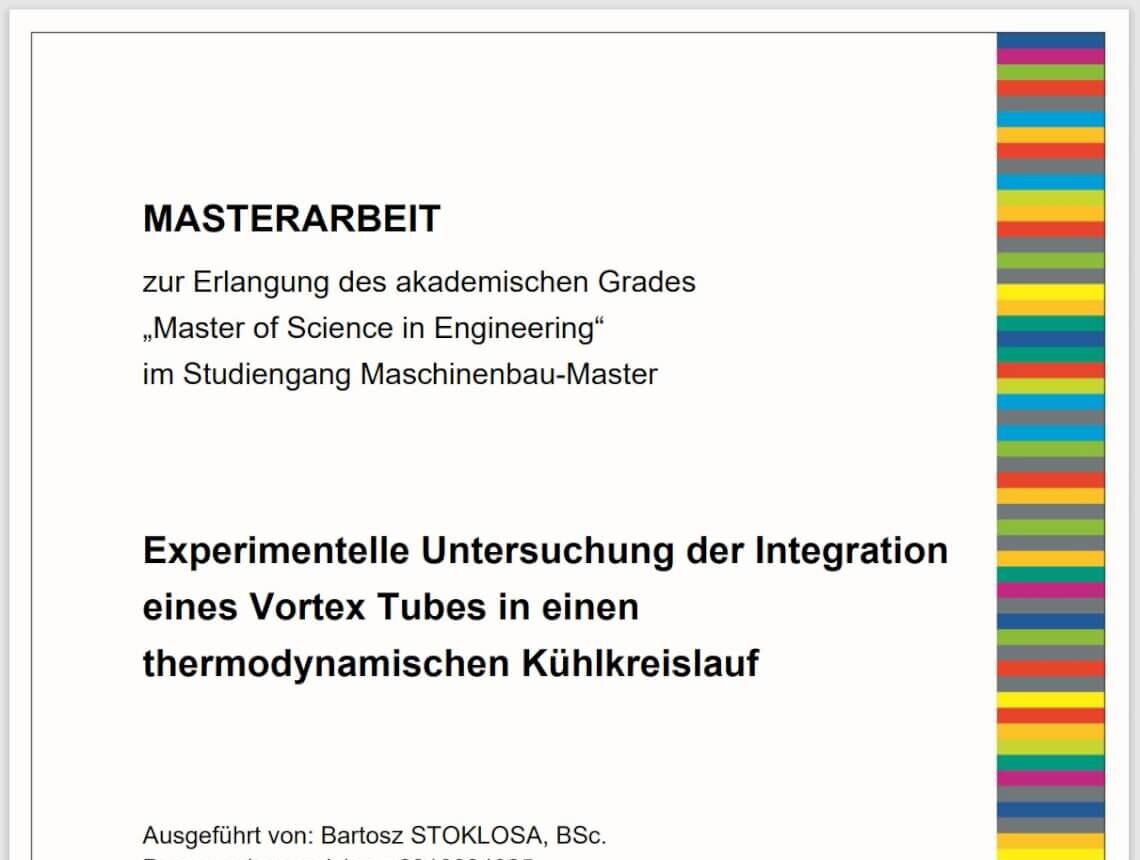
(click on the image to view the full thesis, which we have been permitted to publish here)
Conclusion & outlook:
The results show that vortex tubes are suitable in principle for improving the efficiency of cooling systems. However, it is advisable to further optimise the geometry of the vortex tube and make the compressed air supply more efficient in order to realise its full potential.
Vortex tubes explained: how a vortex tube works
Vortex tubes are small, purely pneumatic devices that use compressed air to produce two air streams at very different temperatures: one hot and one cold. The energy (heat) is therefore redistributed within the air flow. No electricity is needed, as the compressed air itself supplies the required energy.
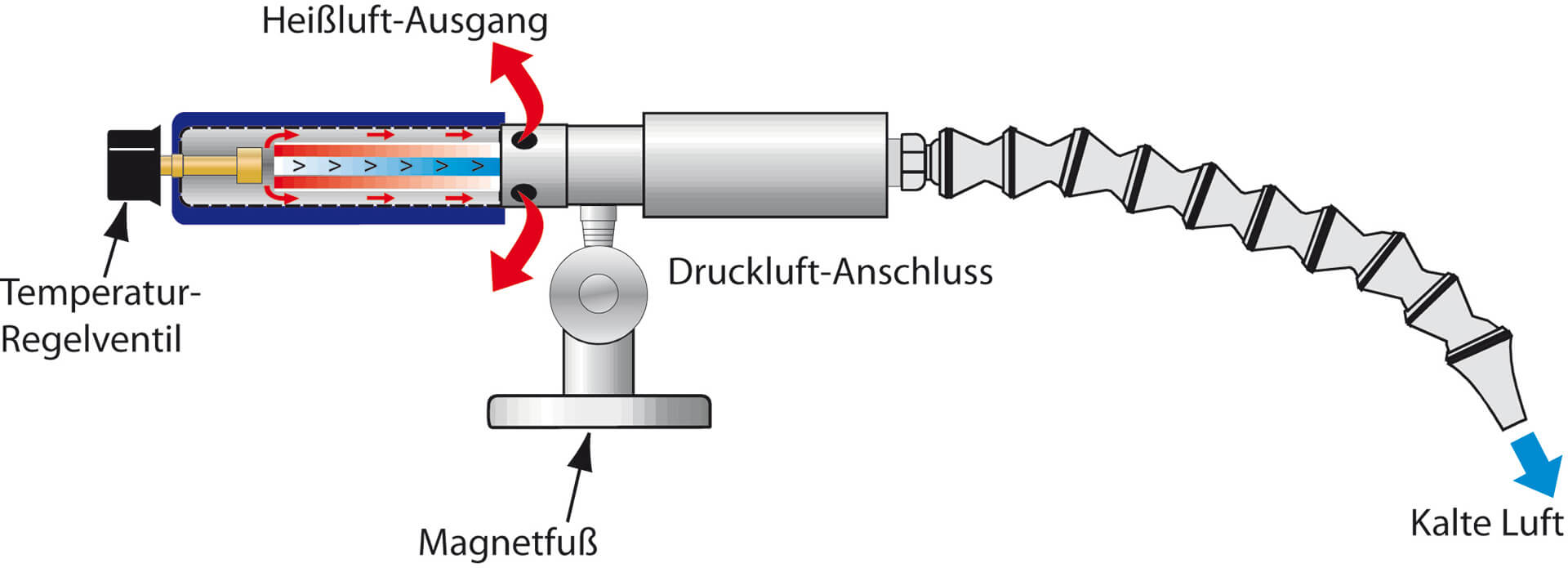
Compressed air inlet: Compressed air is fed into a small cylindrical chamber, creating a strong vortex.
Rotation & centrifugal force: The air spins at very high speed. The outer layer of air is forced outwards and heats up considerably.
Separation into two streams: The hot air stream is discharged at one end through a valve (hot air outlet). The cold air stream is drawn from the centre of the vortex and exits at the other end.
Loan units and expert advice from EPUTEC
Interested in what a vortex tube can do for you? Get free, no-obligation advice from us and simply test it yourself with a high-quality EXAIR loan unit! Product information and models can be found on our website: Vortex tubes and spot cooling