
Compressed air filtration is an essential part of compressed air treatment.
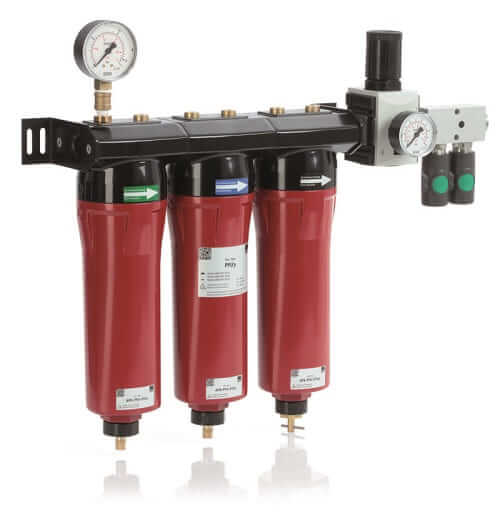
If compressed air consists of compressed but not yet treated ambient air, it contains particles and other contaminants in high concentrations. These include condensate, (fine) dust, abraded particles and oils, which must be separated depending on the application. Certain filters can even remove bacteria, viruses and oil vapours from the compressed air.
To separate the different types of contamination to the required purity, a filtration line is built from various filters. Arranged in a suitable sequence, the filters can treat the compressed air systematically.
(See our diagram: Compressed air treatment)
Types of filter
1. Water separators/cyclone filters
Cyclone filters can separate water, dirt particles and oil droplets. They are not filters in the strict sense, but work like centrifuges. Using the principle of inertia, water separators remove heavier components from the compressed air. The higher the flow velocity and operating pressure, the more effective the process.
Water separators should always be installed upstream of compressed air filters, as drier air has a positive effect on the service life of the downstream filter elements. Cyclone cartridges should also be fitted with a time-controlled or level-controlled condensate drain. This prevents condensate that has already been separated from re-entering the airflow.
2. Microfilters
Microfilters, also called oil filters or wet filters, remove liquid contaminants such as water and oil from the compressed air system. This is usually done with a drainage layer that absorbs the droplets. Microfilters remove particles down to 0.01 micron in diameter with a separation efficiency of 99.9999%. However, this figure does not apply to oil vapour. Depending on the separation efficiency of the filter element, the residual oil content can be reduced to 0.01 mg/m³ (at 20° C).
Air flows through microfilters from the inside out (towards the drainage layer).
3. Dust filters (dry filters)
Depending on their separation efficiency, dust or dry filters are suitable for removing coarse and fine particles from the compressed air stream. Air flows through dust filters from the outside in. The degree of contamination of the filter elements in use can be determined with a differential pressure indicator.
As no condensate is produced during filtration, neither a drainage layer nor a condensate drain is required. Dust filters are mainly used downstream of adsorbers.
4. Activated carbon elements
Activated carbon elements filter oil and hydrocarbon vapours as well as odours and flavours out of the compressed air system. Adhesive forces draw the contaminants onto the activated carbon. The residual oil content is reduced to as little as 0.003 mg/m³ (at 20° C).
With activated carbon elements, water separation/drying is essential, as this protects the filter from water and oil droplets.
Because activated carbon elements cannot regenerate, they must be replaced after approx. 300-400 h.
Filter design and accessories
Compressed air filters consist of a filter housing, a filter element and various accessories.
Filter housing
The filter housing contains a pressure vessel that holds the filter element, a compressed air inlet and outlet, connections for measuring instruments such as the differential pressure indicator, and a condensate outlet.
Filter elements
Alternative filter elements from KSI consist of an inner and outer stainless steel support frame and a filter medium with high-density deep-bed pleating.
A drainage layer made of special fleece further stabilises the filter element and protects against ballooning.
Corrosion-preventing, plasticiser-free plastic end caps prevent efflorescence and inhibit increased bacterial growth.

Condensate drains
Condensate drains discharge the separated liquid from the compressed air system. Depending on the model, this is done either manually or automatically. Level-controlled drains also prevent condensate that has already been separated from re-entering the airflow.
Differential pressure indicator
The differential pressure indicator shows the most economical time to replace a filter element. The differential pressure reveals how contaminated the filter element is. The differential pressure indicator measures the pressure difference upstream and downstream of the filter.
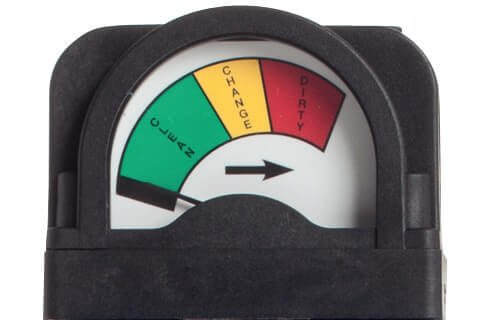
The higher the quality of the filter and the more dirt particles it can hold, the lower the differential pressure. High-quality filters from the KSI ECOCLEAN® series we supply achieve up to 55 % lower differential pressure thanks to a more robust design and improved depth filtration.
Oil test indicators
Oil test indicators measure the oil content in the compressed air stream and so show when activated carbon elements need replacing.
Would you like to know more about compressed air filtration, or do you have a specific application?
We are here for you: by phone, by email and on site!


Daniel Amacher (Switzerland)
Tel. +41 52 53 / 37 964
Mobile +41 76 231 06 73
daniel.amacher@eputec.de



We are happy to support you with:
– Planning, project design & installation of compressed air systems
– Loan units for testing
– Custom builds for your specific requirements
– Technical safety advice & requirements analysis